
The United States has launched a fresh wave of airstrikes against Iran's Islamic Revolutionary Guard Corps (IRGC) in response to a deadly attack in Jordan that claimed the lives of two American service members, aiming to curb Tehran's maritime threats.

US President Donald Trump on Tuesday said that Washington has launched a fresh wave of strikes against Iranian targets near the Strait of Hormuz. They come after what Trump claimed was in retaliation for Iran attempting to add sea mines to the Strait.

US President Donald Trump has announced the cancellation of a planned attack on Iran, contingent on Tehran agreeing to rapidly open the Strait of Hormuz and end its nuclear programme. This decision follows appeals from Middle Eastern countries and includes Israel's commitment, though Iran had previously warned against any "adventurous action" from the US.

A US Air Force colonel, identified by his call sign 'Bravo', survived nearly 50 hours behind Iranian lines after his F-15E fighter jet was shot down near Isfahan. Despite severe injuries, he evaded Iranian forces and was eventually rescued in a complex operation involving US military and intelligence personnel, highlighting a daring mission to leave no man behind.

An Iranian missile strike on Haifa has resulted in casualties and intensified conflict between Iran and Israel, prompting search operations and ceasefire discussions.

The United States used an array of weapons in the strikes conducted against Iran as part of Operation Epic Fury on Saturday -- which included artificial intelligence services from Anthropic, according to a report by Reuters.

Defence experts said the capability of Bagheera has to be tested and validated under India's harsh conditions during summer months in deserts. But it assumes significance as the ability to destroy an enemy tank before it enters striking distance could prove decisive in future land battles.

US President Donald Trump has cautioned Israeli Prime Minister Benjamin Netanyahu that Israel risks international isolation if it resumes extensive military operations against Iran, following a volatile 24-hour period of escalating cross-border hostilities.

A new analysis by the Institute for the Study of War has warned that Iran could escalate its attacks on Israel by launching large missile salvos aimed at maximising psychological pressure on civilians.

US President Donald Trump has abruptly withdrawn from a peace deal with Iran, citing fresh intelligence of Iranian assaults on commercial vessels in the Strait of Hormuz. The decision, made just a fortnight after celebrating the deal, has led to a significant military escalation in the region, with the US launching extensive counter-operations against Iranian military infrastructure.

Trump claimed on social media that recent US-Iran discussions were 'very good and productive' and aimed at a 'complete and total resolution' of the conflict.

Iran's Revolutionary Guard Corps (IRGC) has claimed responsibility for strikes on an American base, alleging it was in response to earlier aerial attacks near Bandar Abbas Airport. The incident follows reports of confrontations between Iranian and US forces in the Strait of Hormuz.

Addressing a media stakeout at the United Nations on Tuesday, Israel's envoy said the country's primary objective remained preventing Iran from acquiring nuclear capabilities.

Iran's Islamic Revolutionary Guard Corps (IRGC) has claimed to have targeted and destroyed hangars of F-35 fighter jets and struck 21 American air and naval bases across West Asia and the Gulf region, including the US Army's command and control centre at the Al-Azraq base in Jordan and the US Fifth Fleet headquarters in Bahrain.

After the Israeli attack on Iran's South Pars Gas Field on Wednesday night, in retaliation, Iran struck Qatar's Ras Laffan Industrial City, resulting in extensive damage, as per the country's Ministry of Defence.

Hegseth said the military campaign, code-named Operation Epic Fury, against Iran is "laser focused" and "decisive," with objectives set directly by the US administration remaining unchanged since the start of operations.

Falling debris from an intercepted Iranian drone caused a 'limited fire' at Saudi Aramco's Ras Tanura refining facility in Saudi Arabia, Saudi Defence Ministry spokesperson Turki Al-Maliki said, according to Al Arabiya.

Tensions in West Asia have dramatically escalated as Israel launched targeted military operations against Iran, triggering widespread blasts across strategic cities, following earlier Iranian projectile attacks on Israel.

The US Central Command (CENTCOM) has launched extensive precision strikes across multiple Iranian military installations, deploying both one-way attack aerial and sea drones for the first time, to degrade Tehran's ability to disrupt international maritime trade in the Strait of Hormuz.
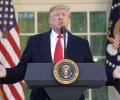
On Tuesday night, Iran launched over a dozen ballistic missiles targeting at least two bases where US military and coalition forces' are stationed in Iraq to 'avenge the killing' of General Qasem Soleimani.

Israeli Prime Minister Benjamin Netanyahu has warned that recent missile attacks demonstrate Iran's capacity to strike globally, posing a threat to Europe and the rest of the world. He highlighted the need for international action to counter Iran's nuclear and missile programmes.

US and Iran officials have reportedly agreed to de-escalate tensions and ensure free passage through the Strait of Hormuz, with technical talks scheduled to continue. This development follows months of conflict, rising gas prices, and strained diplomatic relations, marked by recent retaliatory strikes and threats from both sides. Further discussions on Iran's nuclear program are set to take place in Qatar, highlighting ongoing diplomatic efforts despite recent volatility.

The Israeli Air Force (IAF) said it struck several targets in Tehran, Shiraz and Ahvaz simultaneously over the past 24 hours, targeting sites linked to Iran's ballistic missile programme, air defence systems and military headquarters.

The IRGC had announced earlier that it was carrying out an intense wave of attacks on US and Israeli positons throughout the region since dawn, using missiles as well as drones.
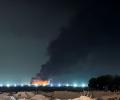
The IRGC said the barrage targeted several US military facilities in the region, including bases at Sheikh Isa in Bahrain, Juffair in Bahrain, Ali al-Salem in Kuwait and Al Azraq in Jordan.

US President Donald Trump on Sunday said that the Israeli strikes on Lebanon's capital of Beirut "should not have happened", warning that such escalation could jeopardise the peace agreement with Iran to achieve a complete solution to the West Asia conflict, which, according to him, is within reach.

In a post on Truth Social, Trump outlined key goals of the campaign, including degrading Iran's missile capabilities, dismantling its defence industrial base, eliminating naval and air power, preventing Tehran from acquiring nuclear capability, and protecting United States allies such as Israel, Saudi Arabia and the United Arab Emirates.

'After we were alerted about the war, none of us could sleep for the next two nights while sailing through those waters.'

The United Arab Emirates Ministry of Defence has announced that the air force and air defence forces have successfully intercepted a significant number of aerial threats following a large-scale Iranian attack that commenced on February 28.

In a post on Truth Social, Trump said the decision followed a request from the Iranian government and added that talks between the two sides were 'going very well'.

Iran's Islamic Revolutionary Guard Corps (IRGC) on Sunday claimed it had destroyed eight US military infrastructures in Kuwait and Bahrain in a joint missile and drone operation, describing the strikes as retaliation for a second wave of US military attacks on Iranian targets.

The IRGC said five missiles were launched at 'the headquarters of the US Army at the Harir Air Base in Erbil, located in Iraq's Kurdistan Region'.

'DRDO has been directed to license missile technologies to the private sector.'

The United States conducted retaliatory strikes against Iran, targeting over 80 sites, after accusing Tehran of attacking commercial vessels in the Strait of Hormuz, while Iran condemned the US decision to revoke a temporary suspension of sanctions on Iranian oil sales.
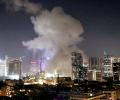
Israel's ongoing airstrikes and Iran's retaliation raised concerns about all-out war between the countries and propelled the region, already on edge, into even greater upheaval.

The threat has raised concerns about possible asymmetric attacks outside the region. Iran has also stepped up attacks on energy infrastructure in Gulf countries.
The Islamic Revolutionary Guard Corps (IRGC) has declared the commencement of its 27th offensive under Operation True Promise 4, targeting American and Israeli positions in response to what it termed a new wave of 'unprovoked US-Israeli aggression against the Islamic Republic', Iranian state broadcaster Press TV reported.

Khamenei captioned the post as 'Victory from God and a near conquest...' In another post, he said, 'The strikes of the resistance front on the worn-out and decaying body of the Zionist regime will be more striking.'

Pakistan's Defence Minister Khawaja Asif has issued a stern warning that the Makkah Defence Alliance, a newly formed pact between Pakistan, Saudi Arabia, and Turkiye, stands ready to activate its collective defence provisions in response to escalating Houthi attacks on Saudi Arabia.

Trump said that Iran's leadership, along with its air defence, Air Force, and Navy are 'gone'.
